
Kerosene Diesel Heater Calculation Formula
Required Heater Output (kW) = (V x AT x K) – 860
Where:
V = Room volume (Length x Width x Height), in m3
T = Desired indoor temperature – Outdoor temperature, in °C
K = Heat loss coefficient (depends on the insulation level of the building)
You need enough heating capacity to reach and maintain a comfortable working temperature. But oversized heaters waste fuel by overshooting the target temperature and cycling on/off too frequently.
What size kerosene heater do I need?
Avoid these common mistakes when estimating your requirements: Instead of relying on floor area alone, calculate the approximate heat loss of the space. This guide will show you how to estimate required heater output in both kilowatts and BTUs. You’ll also learn how to choose the right zobo diesel heater for workshops, warehouses, construction zones, greenhouses and industrial buildings.
Why Heater Size Should Be Based on Room Volume Selecting a heater size is often confusing because many people by asking: ‘How many square feet or square metres will my heater heat?’.
Square metre and square foot ratings are useful, but they only represent part of the heating equation. Consider two structures that each have 200 square metres of floor space: Building A has a ceiling height of 3 metres. Building B has a ceiling height of 8 metres.
Building A holds about 600 cubic metres of air. Building B holds about 1,600 cubic metres of air. That’s much more space to heat. Ceiling height matters because heat rises. A taller structure may require more powerful heating or multiple heaters just to keep the air warm at worker level. The taller building also has a larger exterior surface area through which heat can escape.
For these reasons, professional heater sizing methods typically begin with volume: Room Volume = Length × Width × Height Measure the interior length, width and height of the heated space, in metres. The result will tell you the total volume in cubic metres (or “cu. meters”). Room Volume = Length × Width × Height Example: Length: 20 metres Width: 10 metres Height: 4 metres Room volume = 20 x 10 x 4 = 800 m³
Continue below to learn how to calculate heater capacity based on room volume. You’ll also discover: Why heater size depends on temperature rise & outside temperatures How building insulation affects required heater output Examples of heater sizing calculations for real buildings How to choose the correct insulation factor (K) What size diesel heater do you need?
Formula & Examples Choose heater size based on room volume, temperature difference & insulation quality. zobo Diesel Heater Size & Output Guide Should you choose the exact calculated heater size? Direct-Fired or Indirect-Fired heater?
Additional Factors that Affect Heater Size Selection Kerosene Fuel vs Diesel Fuel: What’s the Difference? Safety Considerations, Ventilation and Final Thoughts The Three Main Factors That Determine Heater Size
1. Room Volume Obvious, but still important: The bigger the space, the more heating power you will probably need. A small corner workshop can often use a small heater to keep basic jobs comfortable. Large industrial buildings or warehouses with high ceilings may require several smaller heaters or one very large unit. The key point is this: Don’t forget about unused vertical space! Keep in mind that warm air rises.
2. Temperature Rise Required temperature rise refers to how much you want the heater to increase the air temperature. Example: Your indoor thermostat is set to 18° Celsius but it is currently -2° Celsius outside. That’s a temperature rise of: T = Desired Indoor Temperature − Outdoor Temperature T = 18°C − (−2°C) = 20°C When the outdoor temperature is 10°C, heating a building up to 18°C is fairly easy. When the outdoor temperature is -10°C, heating a building up to 18°C is much harder. For sizing purposes, always use a worst-case outdoor temperature for your area instead of the current daytime temperature.
3. Building Insulation Think of insulation as a ‘resistance to heat loss’. A modern workshop with insulated walls may lose heat slowly. An open warehouse with metal walls will lose heat quickly. To account for insulation, you can use a simplified heat-loss coefficient K: Insulation can range from excellent to very poor:
Insulation Description | Approximate K Value | Excellent insulation, new construction | 0.6–0.9 | Good insulation, double pane windows, sealed doors | 1.0–1.5 | Typical insulation (single pane windows, few gaps) | 1.6–2.0 | Little to no insulation | 2.1–3.0 | Poor insulation, rarely heated building | 3.1–4.0 | Keep in mind that doors, windows and loading docks can dramatically increase heat loss if they are not properly sealed.
Kerosene Heater Size Calculation Formula Required Heater Output (kilowatts) = Volume × Temperature Difference × K ÷ 860 K = Heat loss coefficient depending on the building’s insulation (see values above) Volume = Room volume in cubic metres (cu. meters). Temperature difference = Indoor temperature (thermostat setting) – Outdoor temperature 860 = Approximate number of kilocalories per hour equal to 1 kW. If you’ve done the math correctly, the units will all cancel out and you’ll be left with “kilowatts” as the answer.
If it helps, try thinking of this equation like: Required heating output = Volume of space ÷ 860 adjusted by Temperature Difference and Insulation Factor. Example 1: Medium-Size Workshop Let’s say you have a workshop measuring: Length: 15 metres Width: 10 metres Height: 4 metres You want to maintain a temperature of 18°C when it’s 3°C outside. Your workshop has average insulation, so K = 1.8. First calculate the volume: Volume = Length x Width x Height = 15 x 10 x 4 = 600 m³ Next calculate the temperature difference: T = Desired Indoor Temperature – Outdoor Temperature = 18 – 3 = 15°C. Now plug those numbers into the heater-sizing formula: Required heater output = Volume x ΔT x K ÷ 860 = 600 x 15 x 1.8 ÷ 860 = 18.84 kW.
Our example workshop needs about 18.8 kW of heating capacity to reach and maintain 18°C while it’s 3°C outside. Therefore, a 20 kW zobo diesel heater would be an appropriate choice. Realistically, you’ll also want to consider how often the doors open, whether you need to heat the whole room or just a workspace. Plus, do you plan to leave the heater on 24/7 or only turn it on when workers are present? These factors can change the required heater size slightly.
Example 2: Warehouse with Frequent Door Opening Let’s try another example. Assume you have a warehouse with the following dimensions: Length: 20 metres Width: 10 metres Height: 4 metres Outdoor temperature = -2°C. You set the thermostat to 18°C. Your walls have good-to-average insulation, so we’ll assume K = 1.5. Calculate volume: Volume = 20 × 10 × 4 = 800 m³ Calculate temperature difference: T = 18 – ( −2 ) = 20°C. Now we just need to solve for “Required Heater Output”. Required heater output = Volume × Temperature Difference × K ÷ 860 Required heater output = 800 × 20 × 1.5 ÷ 860 = 27.91 kW Estimated heater requirement = ~28 kW. Based on this math, a 30 kW diesel heater should do the trick. Remember our note about open doors/walls from above? Let’s say that this warehouse has large doors which will be opening frequently. In that case, heat loss will be even higher. A 37 kW diesel heater might be more appropriate. That way you have ample headroom to reheat the space quickly after doors are opened during loading.
Example 3: Large Industrial Building Now that you have a better idea of how this works, try calculating heater size for a large building by yourself. Use this example as a check. Size of building: Length: 40 metres Width: 20 metres Height: 6 metres Outdoor temperature = -10°C Thermostat temperature = 15°C Insulation quality = Good-to-average Calculate room volume: Volume = Length × Width × Height = 40 x 20 x 6 = 4,800 cu. meters. Calculate Temperature Difference: T = Desired Temperature – Outdoor Temperature = 15 – ( −10 ) = 25°C Required heater output = Volume × ΔT × K ÷ 860 = 4,800 × 25 × 1.5 ÷ 860 = 209.30 kW. Total heat requirement is approximately 209 kW. We recommend multiple heaters instead of a single unit.
For example: 1 x 150 kW zobo diesel heater + 1 x 63 kW zobo diesel heater = Approximately 213 kW combined heat output. Using two or more heaters can help distribute heat better than a single unit. It can also allow you to set up separate heating zones within the same building. You could place one heater near the loading dock and another near your workspace.
How big should my diesel heater be?
zobo offers diesel-fuel heaters ranging from 13 kW to 150 kW:
Below are some general guidelines for matching workshop & warehouse sizes to heater output. This chart will give you approximate BTU ratings to compare against other models you may be considering.
zobo Heater Size | Approximate BTU Output | Typical Applications |
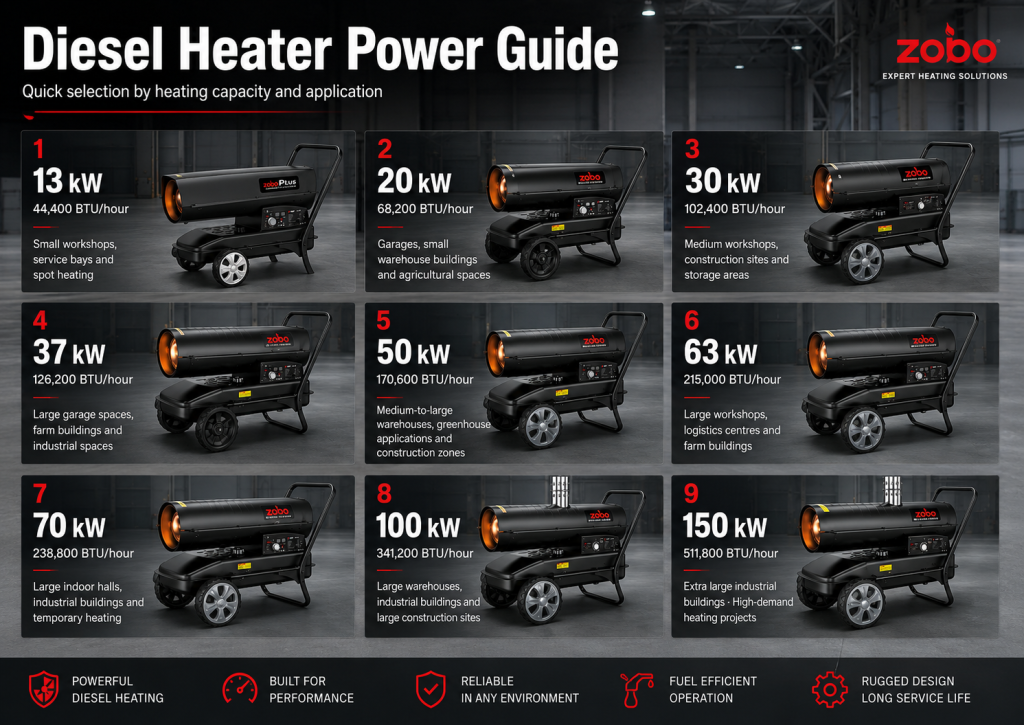
13 kW | 44,400 BTU/ hour | Small workshops, service bays and spot heating. |
20 kW | 68,200 BTU/ hour | Garages, small warehouse buildings and agricultural spaces. |
30 kW | 102,400 BTU/ hour | Medium workshops, construction sites and storage areas. |
37 kW | 126,200 BTU/ hour | Large garage spaces, farm buildings and industrial spaces. |
50 kW | 170,600 BTU/ hour | Medium-to-large warehouses, greenhouse applications and construction zones. |
63 kW | 215,000 BTU/ hour | Large workshops, logistics centres and farm buildings. |
70 kW | 238,800 BTU/ hour | Large indoor halls, industrial buildings and temporary heaters. |
100 kW | 341,200 BTU/ hour | Large warehouses, industrial buildings and large construction sites. |
150 kW | 511,800 BTU/ hour | Extra large industrial buildings. High demand heating projects. |
Suppose the heater size calculator tells you that you need a 28 kW heater. It’s rarely a good idea to buy the 25 kW model just because it’s close to the calculated requirement. Always allow for a small amount of ‘buffer capacity’. The benefits of slightly oversizing your heater include: Ability to heat the space faster after start-up. Ability to recover after doors open. Better performance if the weather gets colder than expected. Some leniency for small air leaks, if any. Ability to maintain temperature without running at full capacity all the time.
Of course, buying the largest heater possible is not always better. An oversized heater will create hot and cold spots. It may also cycle on/off too frequently. As with every rule of thumb, there can be exceptions. However, choosing a slightly higher-capacity heater versus the exact calculated size is almost always a good decision.
Direct-Fired or Indirect-Fired Heater?
So now you know how to choose the right size kerosene or diesel heater. But there’s still one more question to answer: Which type of heater should you choose? Direct-Fired Heaters vs Indirect-Fired Heaters Direct-Fired Heaters A direct-fired heater sends the heated air and combustion by-products directly into your work area. This provides a large volume of heat quickly and efficiently. Direct-fired heaters are best for open, partially open or very well ventilated areas. Because the combustion process introduces additional humidity into the heated air, ventilation is important. You would typically use a direct-fired heater for: Open construction sites. Partial sheds. Spaces with excellent ventilation. Outdoors or semi-outdoor areas.
Indirect-Fired Heaters An indirect-fired heater has a combustion chamber and heat exchanger. Combustion gases are vented separately from the heated air. Indoor heaters must normally vent these gases outdoors. You should typically choose indirect-fired heaters when: Heating an enclosed area with workers present. Installing a heater in a warehouse. Providing heat for indoor events. Heating livestock buildings or temporary shelters. Using a heater indoors for construction or drying purposes. An indirect-fired heater is usually preferred when other materials or livestock could be impacted by combustion by-products. This is not set-in-stone advice. Always follow the manufacturer’s instructions for safe heater installation.
Additional Factors that Affect Heater Sizing Air Leakage Air leaking into your building from outside will increase heating demand. Before buying a bigger heater, make sure there are no unnecessary gaps around doors/windows.
Door Opening Frequency How often will the door open? If it’s several minutes or hours between door openings, the heat loss may not matter much. However, if your warehouse doors will be opening every few minutes, that open door can suck out a tremendous amount of heated air. Heavy-duty loading docks may require additional heater capacity or separate heating zones.
Warm-Up Time How quickly do you need to warm up the building?
Our formula calculates how much power you need to compensate for heat loss at your target temperature. If you would also like to warm-up the building quickly, you may need heaters with more available capacity. A separate heater could be used to provide additional “boost” capacity when necessary. Heat Distribution No matter how much heating capacity you add, you won’t feel comfortable if heated air cannot reach you. If warm air rises to the ceiling without spreading horizontally, you may also feel cold. Large buildings can often benefit from multiple heaters or heaters with built-in air circulation fans.
Flexible ducting can help direct warm air where you need it. Localized Heating You may not need to heat the entire building. In some cases, it might make sense to only heat the active work area of a large workshop. Using a 30 kW or 37 kW zobo diesel heater to directly heat workers and equipment might be easier than trying to heat an entire 6 metre high warehouse building.
Kerosene Fuel vs Diesel Fuel: What’s the Difference?
Gasoline-powered heaters are obviously NOT an option for industrial spaces. This leaves us with two choices: Kerosene heaters or diesel heaters. Both use liquid fuel and produce heat through direct combustion. However, not every diesel heater accepts every type of diesel fuel. Always double-check: The product nameplate The owner’s manual Local regulations (if applicable) Fuel nozzle & combustion settings Cold-weather performance data. Never assume that ‘every diesel heater can use kerosene’. Or that ‘every kerosene heater can use all types of diesel fuel’.
Pay attention to the intended fuel type before you buy. Safety and Building Codes, Ventilation Install heaters correctly and follow all operating instructions. If installing heaters in a confined space, make absolutely sure there is enough ventilation to supply fresh air. Employees also need enough oxygen to breathe while the heater is operating. Remember that heaters produce CO emissions and cannot be used in confined areas without outside ventilation.
Heater safety guidelines require heaters to be: Mounted with proper clearance from combustible materials. Stable (all legs on the ground) during operation. Connected to an outside vent if required by the heater model. Safety concerns are not covered by our heater-sizing formula. Always use heater systems correctly and safely.
Common Heater Sizing Mistakes to Avoid Use the volume of space, not just floor area. Size heaters based on the lowest outdoor temperature you expect to encounter. Estimate insulation quality realistically. Don’t automatically buy the smallest heater in the desired output range. Don’t automatically buy the largest heater you find. Bigger isn’t always better. Distribution matters. Be sure you are comparing “output” ratings, not fuel “input” rates.
Example: Just because two heaters are both rated at 30 kW doesn’t mean they will put out the same amount of heat. Check the specifications carefully. Final Answer: What Size Kerosene Heater Do I Need? Calculate room volume: Length x Width x Height = Room Volume in cubic metres Calculate Temperature Difference: Set Temperature – Outdoor Temperature = ΔT Pick an insulation rating (K) between 0.6 and 4.0 Plug those numbers into our heater output formula: Volume × ΔT x K ÷ 860 = Required heater output in kW. Consult the appropriate fuel guide to find a suitable unit. Example: Diesel heater sizes range from 13 kW to 150 kW. Buy the heater size at or slightly above the required heater output.