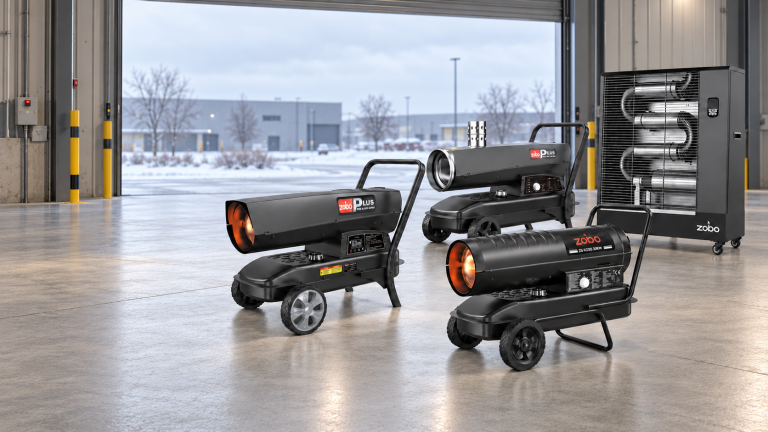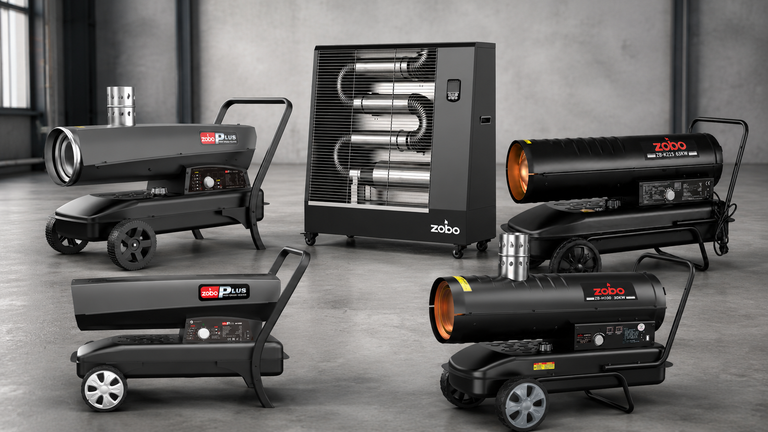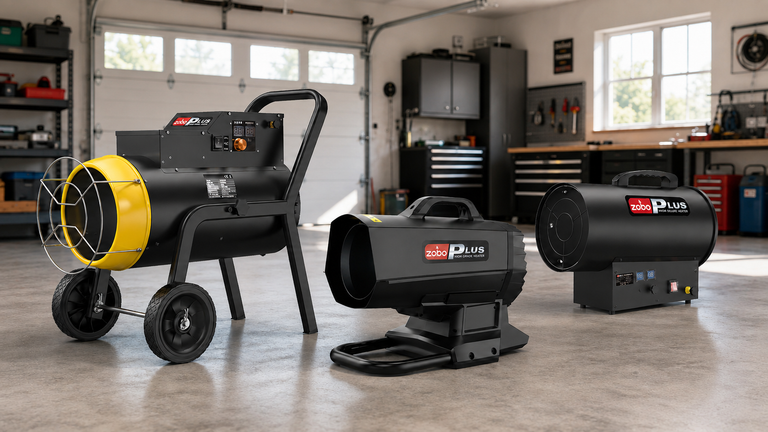

This propane heater user guide explains how gas heaters work, what Is a gas propane heater? how to use a propane heater safely and answers the question “can you use a propane heater indoors?”
When it’s cold outside, a gas heater can deliver quick and powerful heat to workshops, construction sites, warehouses, agricultural buildings and other chilly work environments.
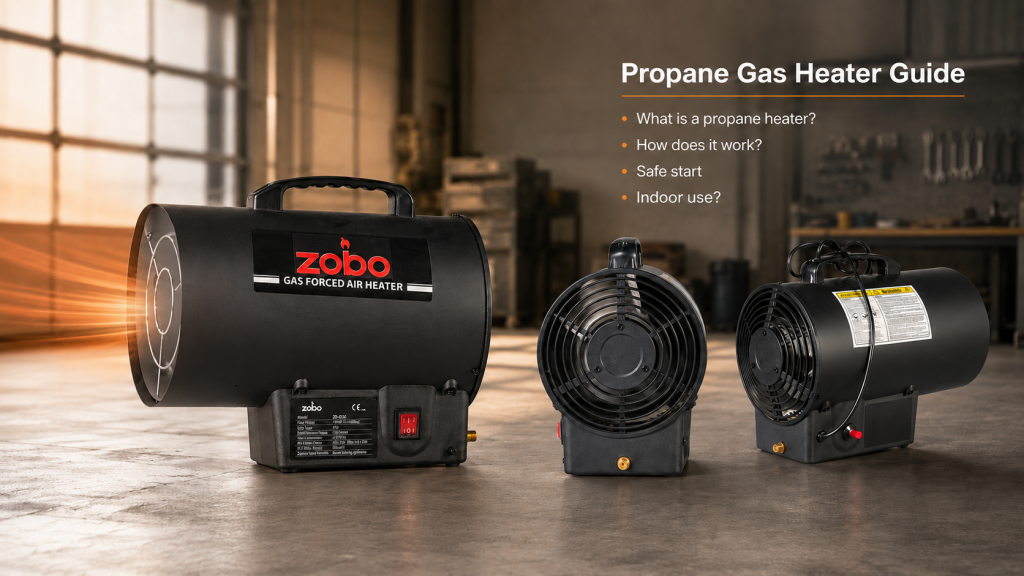
Propane heaters are popular because they’re portable, can quickly heat an area and don’t require connection to a natural gas supply.
But if you’re considering a propane heater—or planning to operate one for the first time—you may have questions like:
- How does a gas heater work?
- What is a propane heater?
- How do you start a gas heater safely?
- Can you use a propane heater indoors?
These are important questions. A propane heater is a fuel burning appliance. It’s important to understand how it works—and where it can safely be used—not just its heating output.
In this guide we cover:
- What is a propane heater?
- How does a gas heater work?
- How to start a propane heater safely
- Can you use a propane heater indoors?
What Is a Propane Heater?
A propane heater is a heating appliance that burns propane gas to produce heat.
Propane gas is normally stored under pressure as a liquid in a cylinder or tank. Once released from the cylinder it evaporates and becomes a gas that can be fed to a burner.
Propane has almost no odor naturally, so chemicals are added to help you detect leaks.
Propane heaters come in various styles, including:
- Forced-air propane heaters
- Radiant propane heaters
- Convection heaters
- Patio heaters
- Wall-mounted gas heaters
- Vented propane heaters
- Direct-fired industrial gas heaters
The propane heater in this guide is a portable propane forced-air heater that’s direct-fired.
Direct-fired heaters are often used when people need a large volume of warm air fast instead of slower localized heating. Common applications include construction sites, workshops, industrial working areas and agricultural facilities.
How Does a Gas Heater Work?
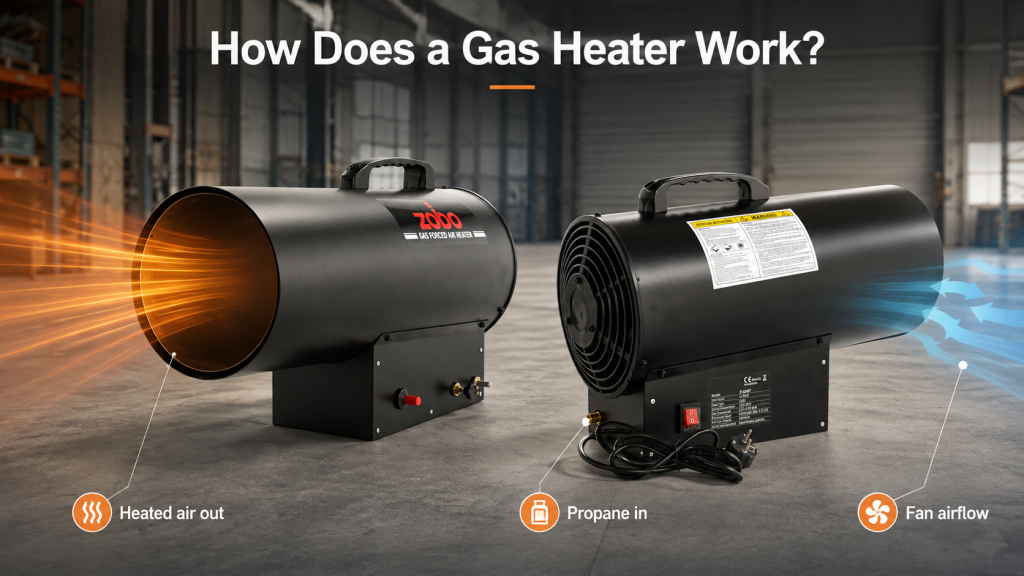
Gas heaters can be different styles and designs, but the basic working principle is similar.
This type of propane heater uses three simple elements:
Fuel + air + ignition
Once propane gas is supplied to the burner, mixed with air and ignited. The combustion produces heat, while an electric fan draws air into the heater and forces hot air out into the room.
Starting up and understanding how a gas heater works can be simplified into five steps:
- Propane Is Supplied to the Heater
The propane tank attaches to the heater with a regulator and gas hose.
The regulator reduces the pressure from the propane tank so fuel can flow to the burner at the correct pressure needed by the heater.
Make sure you use the correct regulator (regulators are not universal). Check that the gas hose is connected securely to the heater and isn’t twisted, crushed or kinked. All connections must be tight and gas tight before starting the heater.
Never tamper with or arbitrarily adjust a gas regulator unless directed to do so by the manufacturer.
- The Electric Fan Starts Moving Air Into the Heater
Portable forced-air gas heaters typically use electricity to power the fan. Propane provides the heat, but electricity supplies the force necessary to distribute warm air.
When connected to the correct electrical supply and switched on, the electric motor spins the fan. As it rotates, the fan pulls cooler air into the back of the heater and pushes it through.
Incoming air serves two purposes:
Provides necessary air for combustion to occur
Moves generated heat away from the heater and forces warm air into the work area
Don’t block the air intake or outlet vent. Boxes, walls, heater covers, insulation, wood products or other items should not obstruct airflow. If airflow is restricted, the heater may not operate correctly and could cause a dangerous condition to occur.
- Propane And Air Enter Heater Combustion Area
When the valve on the propane tank is opened, gas flows through the regulator and hose into the heater.
In a direct-fired heater, the gas enters the burner and mixes with air that’s being drawn into the combustion chamber.
Correct fuel to air mixture is important for stable and efficient combustion. Insufficient air can cause poor combustion. That’s another reason why ventilation and unrestricted airflow is critical when operating fuel burning heaters.
- Ignition System Lights the Burner
The operator presses the safety gas valve and ignition button.
On some heaters, including the example in this guide, the ignition system is piezoelectric. Pressing the ignition button creates a spark near the burner. When the propane-air mixture ignites, flame appears inside the heater’s combustion chamber.
The safety valve usually needs to remain activated for a few seconds after ignition. This allows the heater to establish stable operation.
Depending on the heater, different safety mechanisms may monitor burner operation and/or prevent continued gas flow if certain conditions aren’t met.
- Heater Fan Delivers Heated Air to the Room
After the burner fires, the fan will continually draw air through the heater. As air passes through, it absorbs heat and is discharged out the front of the heater as a stream of warm air.
This is a direct-fired heater, so there’s no heat exchanger and exhaust flue separating combustion heat from airflow. As a result, direct-fired gas heaters can heat an area very quickly and provide high thermal efficiency.
Direct-fired heaters do this by forcing combustion products into the room being heated. Proper ventilation is why natural ventilation is so important.
How to Start a Propane Heater
Starting procedure will vary from model to model. Always read and follow the instructions provided with your heater.
For the portable propane heater we’re covering here, general startup procedure is as follows:
Step 1: Check Heater Before Starting
Look over the heater and area around it before turning it on. Check that:
Correct gas regulator is installed
Gas hose is connected securely
Gas hose is not twisted, crushed or kinked
Air inlet is clear of obstruction
Warm-air outlet is not covered or blocked
Heater is sitting on a stable surface and won’t tip over
Area has adequate ventilation
Environment meets conditions allowed by heater instructions
Don’t start the heater if the gas connection is damaged or you suspect a gas leak.
Step 2: Connect Electrical Supply
Connect heater’s power cord to a wall outlet that matches the heater’s electrical specifications.
Flip the ON/OFF switch to “ON.” The fan should start turning. Wait approximately 30 seconds after turning on the fan before igniting the heater. Some instructions recommend confirming the fan works properly before ignition. Confirming the fan works before ignition also helps clear any remaining gas in the heater before igniting.
If the fan doesn’t operate properly don’t continue with ignition.
Step 3: Connect Propane Supply
Ensure gas hose is connected properly to the gas inlet on heater.
Connection should be secure, with no gas hose that’s:
Twisted
Pinched
Kinked
Damaged
Placed where it could come into contact with excessive heat
Slowly open propane cylinder valve. Never open the valve abruptly.
Step 4: Press and Hold Safety Start Valve
Press and hold the heaters safety start button.
Allowing gas to reach the burner during ignition. Do not release button yet.
Step 5: Press Ignition Button
While continuing to hold down safety start valve, press the ignition button several times until burner ignites.
Confirm burner is lit. Don’t continuously press ignition button if heater doesn’t ignite immediately.
What If My Gas Heater Does Not Light?
If heater does not light within 30 seconds, stop trying to ignite the heater. Wait at least 3 minutes before trying to ignite the heater again.
This pause is required because there may be unburned gas present at the burner after a failed ignition attempt. Never continue to press the ignition button without waiting.
Step 6: Keep Safety Valve Pressed After Lighting
Once burner lights, continue to hold safety valve for about 30 seconds then release slowly. Heater should remain operating.
If flame goes out, don’t try to bypass safety feature. Turn unit off and review troubleshooting instructions from manufacturer.
Step 7: Adjust Airflow if Needed
Some direct-fired gas heaters are equipped with an airflow adjustment control or “relief adjustment.”
On the heater discussed in this manual, turning adjustment knob one way decreases airflow. Turning in the opposite direction increases airflow.
Only make adjustments outlined in heater instructions. Never try to adjust the gas regulator, burner or safety components to increase heating output.
Can You Use a Propane Heater Indoors?
Here’s the most important question of this guide. Can you use a propane heater indoors?
Answer: It depends on what type of heater you have.
Outdoor-only propane heaters should never be used indoors or in an enclosed space. According to the US Consumer Product Safety Commission, “Portable propane space heaters should not be used indoors or in other confined spaces unless the product is specifically designed for that use.”
The Propane Education & Research Council echoes, “Keep in mind that portable heaters should be operated indoors only when they are specifically designed and approved for indoor use.”
Remember we’re discussing direct-fired industrial heaters. For this type of heater, proper fresh-air ventilation is critical. And never use the heater in an enclosed space contrary to the manufacturer’s instructions.
Why Does a Propane Heater Require Ventilation?
Propane combustion uses up oxygen.
While burning, appliances also produce gases that shouldn’t build up in an occupied space. Carbon monoxide (CO) is always a concern with combustion appliances. Even direct-fired heaters that achieve more efficient combustion than other propane heaters can still produce CO under certain conditions.
Inadequate ventilation, improper burner operation, restricted airflow, incorrect adjustment or equipment malfunction may increase risk.
OSHA specifically states “wherever temporary heaters are used in confined work areas, sufficient fresh air must be provided. In areas where natural ventilation is insufficient, additional mechanical ventilation must be used.”
Ventilation isn’t optional.
What is Carbon Monoxide and Why is it Dangerous?
Carbon monoxide (CO) is a toxic gas that’s produced by incomplete combustion of carbon-based fuels. This includes propane, gasoline, natural gas and more.
Normal human senses can’t reliably detect CO. Symptoms of CO poisoning include:
Headache
Dizziness
Weakness
Nausea
Confusion
Unusual tiredness
High concentrations or prolonged exposure can cause carbon monoxide poisoning deaths. For this reason, OSHA places emphasis on ventilation and proper equipment maintenance in places where CO can be generated.
Closed, poorly ventilated rooms present the highest risk. CPSC research has found that using a portable propane heater in a small enclosed space without enough ventilation can lead to dangerous levels of carbon monoxide.
Choosing the Right Propane Heater
Instead of comparing propane heaters based only on price or peak BTU output,considerations for professional buyers include:
- Heating Capacity
Size the heater to the actual volume and heat loss of the workspace.
A heater that is too small will cycle on and off without heating the room adequately.
A larger heater may be difficult to heat a small space with efficiency. - Airflow
On a forced-air heater, heating capacity is only part of the formula.
The unit also needs to move the warmed air efficiently.
Good airflow will push heat throughout a large work area without stagnating near the heater outlet. - Easy Ignition
An intuitive ignition system is nice to have when a heater will see daily use.
zobo gas heaters feature a convenient manual ignition system on select models.
Operators can easily start the heater using a simple mechanical sequence.
No complex programming is required.
When you are renting equipment to others, or using a heater frequently yourself,it doesn’t make sense to have complicated controls.
Simple gas heater operation is nice to have for rental fleets,distributors,contractors and agricultural industries. - Safety Protection
Look for safety features when comparing commercial heaters.
Useful protection features will vary between models, but can include:
- Overheat thermostat protection
- Tip-Over switch protection
- Safety gas valve
- Flame-related protection
- Stable supporting base
zobo heaters are engineered with helpful protection features ideal for rugged heating applications.
Confirm the specific protections included on a model before purchase.
- Regulator and Gas Hose
Pay attention to the small stuff.
Your heater won’t work without proper fuel connectors.
On select zobo gas heater models, we can include a regulator and hose with your heater purchase.
This allows distributors and project buyers to purchase a heater with more of the needed parts included.
Buying in volume? Don’t forget the little things. - Portability
Many industrial heaters need to be portable.
They may be moved between buildings on different days of the week.
A handy carry handle and lightweight design will allow easier relocation.
Portable heaters are great for:
- Contractors
- Maintenance crews
- Farm work
- Equipment rentals
- Warehouse operations
- Seasonal projects
- zobo designs our gas heaters with portable applications in mind.
Why Choose a zobo Heater?
For most commercial buyers,a portable propane heater isn’t a hobby or a curiosity.
When shopping for industrial heaters,your goal should be to find a heater that does its job,and does it well.
Ignites quickly.
Heat reaches your workspace rapidly.
Move the heater to where you need it.
Operation is intuitive and uncomplicated.
zobo creates industrial space heaters for use in commercial,farm,construction, and other professional heating applications.
zobo takes an intuitive, everyman approach to building our line of propane space heaters.
Contact zobo about our gas heaters today.
For portable gas heater models,zobo focuses on four simple, but important areas:
Fast Ambient Heating
zobo gas heaters don’t take long to heat a workspace.
Built with a powerful burner and fan combination,zobo heaters push warm air into your work area quickly.
Easy Manual Ignition
zobo heaters are simple to use.
There are no hidden controls or complicated programming sequences.
Manual ignition starts the heater quickly and efficiently.
Built to Move
Don’t wrench loose pipe fittings while relocating a zobo heater.
zobo gas heaters are built with portability in mind.
Safety Features
zobo includes many helpful features to help keep heaters safe during operation.
Includes Regulator and Hose
Because zobo understands the importance of convenient accessories,
some zobo gas heaters can be purchased with a propane regulator and hose.
Commercial Heating Solutions
Too many gas heater brands try to market heaters as consumer appliances.
But industrial heating requirements are not the same as home heating needs.
zobo develops commercial propane heaters for commercial businesses and professional buyers.
Let us help you find the perfect heater.
zobo manufactures propane heaters for wholesalers,distributors,retailers,and project buyers.
We offer a variety of gas heater configurations to suit different market segments and purchasing needs.
Need a heater for your business? Fill out the form to the right or Contact us today!
Where Should You Not Use an Outdoor Propane Heater?
If the heater isn’t designed, certified and instructed for use in that environment, don’t assume it’s safe to use just because there is enough physical space in the room.
Do not use outdoor-only portable propane heaters in rooms, enclosures or spaces like:
Bedrooms
Living rooms
Closed garages
Small storage closets
Tents
Camper vans
Cars
Trucks
Vans
Closed shed storage
CPSC warns of the dangers of CO poisoning specifically related to using portable heaters in tents, campers and vehicles. Opening a window slightly is not a substitute for following the heater manufacturer’s ventilation guidelines.
What About Workshops, Warehouses & Construction Sites?
The answer to this question is more nuanced. Some industrial space heaters and construction heaters are designed to be used for temporary heating in large well ventilated working areas.
A large workshop with controlled fresh-air ventilation is very different than a sealed off camper or bedroom.
However, “large building” doesn’t always equal safe ventilation. Heater manufacturer instructions, product certification, local regulations, heater output, room volume and actual ventilation all play a role.
OSHA requires that “whenever temporary heating equipment is used in confined work areas, sufficient fresh air must be supplied to the area.” Additionally, “where natural ventilation is insufficient, additional mechanical ventilation must be used.”
That means proper ventilation is required by law; it’s not optional.
How to More Safely Use a Propane Heater
Safe operation starts before you even turn the heater on.
Keep Air Intake Clear
Don’t block the heater’s rear air inlet with a wall, plastic cover, curtains, insulation foam, boxes or piled cartons. The fan needs sufficient airflow to draw into the heater.
Check Hose
Visually inspect the propane fuel line before operating heater. Don’t use the heater with a gas hose that’s visibly damaged, crushed or kinked.
Use Proper Regulator
The regulator is part of the heater’s fuel delivery system. Don’t replace it with a different component or make any unauthorized adjustments.
Open Cylinder Valve Slowly
This allows gas to enter the system in a controlled manner.
Don’t Ignore Continued Ignition Failure
If heater fails to ignite, stop attempting ignition. For the heater instructions we provided in this guide: If ignition doesn’t occur within 30 seconds, wait at least 3 minutes before trying to light it again.
Repeatedly trying to introduce gas into the heater without igniting can create a dangerous condition. Shut off heater and review the troubleshooting section of the owners manual if ignition problems occur.
Maintain Adequate Ventilation
Just because you want the room to heat up faster, doesn’t mean you should close windows, doors or ventilation openings.
Remember, when using a direct-fired propane heater, proper ventilation is part of safe operation.
FAQs about Propane Gas Heaters
Does a propane heater need electricity?
Some propane heaters require electricity, while others don’t. Portable propane forced-air heaters will normally require electricity to run the motor and fan. Propane radiant heaters or convection heaters may use different designs that don’t require electricity. Check specifications for the individual heater.
Why does my gas heater have a fan?
The fan is used to draw air through the heater. It also evenly distributes heated air across a larger area. Forced-air propane heaters are great for quickly heating large work areas.
Why should the fan run before igniting my propane heater?
Running the fan ensures airflow is present. It also purges out any excess gas remaining in the heater from previous use. Doing this before ignition helps ensure safe operation (per instructions provided with this heater).
What should I do if my propane heater won’t ignite?
Stop attempting ignition. If your propane heater does not ignite within 30 seconds wait at least 3 minutes before trying again to light the heater. If your propane heater continues to fail to ignite, shut it off and review the manufacturers troubleshooting guide. Never continue to press the ignition button without pausing.
Can I use a propane heater in a closed garage?
Don’t use an outdoor-only propane heater in a closed garage. Even if a propane heater is approved for indoor use or a specific work environment, it must still be installed and operated according to ventilation and installation instructions provided by the manufacturer. Never assume because you left a garage door cracked that there’s enough ventilation to safely operate a propane heater.
Can I leave my propane heater on overnight?
You should never leave a fuel burning portable heater unattended or operate while sleeping unless the manufacturer explicitly states that’s an approved operating condition. Always follow the products operating and supervision guidelines. With propane heaters, CO poisoning concerns should always be taken seriously.