
Electricity Use: Average Space Heater Wattage & Cost
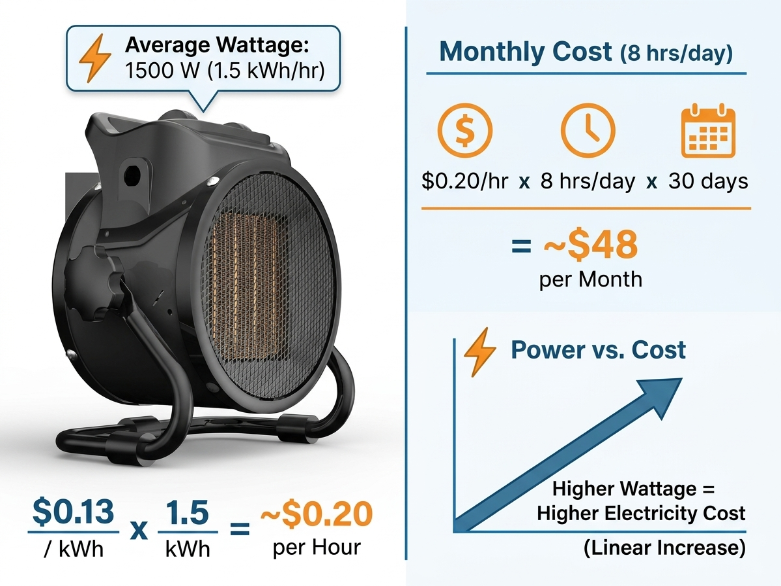
The average portable space heater has a power rating of 1500 watts (equivalent to 1.5 kWh per hour). Assuming electricity costs $0.13 per kWh, you can expect it to cost roughly $0.20 per hour to run.
Over the course of a month running 8 hours per day, your electricity bill can increase by around $48.
The higher the wattage of the electric heater, the more electricity it will consume. So, more powerful heaters will cost you considerably more money to run. Electricity usage & running-costs increase linearly with power rating…
How much does a space heater cost to run?
🔑Quick Answer:
Let’s assume electricity costs $0.13 per kWh.
1500W space heater = 1.5 kWh per hour = ~$0.20/ hour
2000W fan heater = 2.0 kWh per hour = ~$0.26/hour
5000W industrial heater = 5.0 kWh per hour = ~$0.65/hour
✔Electricity Usage Calculator (kWh per Hour) : Wattage ÷ 1,000 = kWh per hour
Example Usage: 12,000 watt heater → 12 kWh per hour
3,000W heater → 3.0 kWh per hour
How much does it cost to run per hour?
Multiply: kWh × cost of electricity = cost per hour
Example: 1.5 kWh x $0.13 = $0.20 per hour
Electricity Cost Table (Per Month)
| Heater Type | Power (W) | Energy Use (kWh/hour) | Cost per Hour (0.13/kWh) | 8 Hours/Day Monthly Cost |
|---|---|---|---|---|
| Portable space heater | 1500W | 1.5 kWh | $0.20 | ~$48 |
| Fan heater | 2000W | 2.0 kWh | $0.26 | ~$62 |
| Small fan heater | 1000W | 1.0 kWh | $0.13 | ~$31 |
| Fan blow heater | 3000W | 3.0 kWh | $0.39 | ~$94 |
| Industrial heater | 5000W | 5.0 kWh | $0.65 | ~$156 |
Real World Example: Space Heater Electricity Cost
Here’s an example of what you can expect to pay based on the average electricity rate in the U.S.
15,000 Watt Space Heater:
1.5 kWh x $0.13 = $0.20 operating cost per hour
Run for 8 hours per day
$0.20 per hour x 8 hours = $1.60 per day
$1.60 x 30 days = $48 per month
2,000 Watt Fan Heater:
2.0 kWh x $0.13 = $0.26 operating cost per hour
✔Run for 8 hours per day
$0.26 per hour x 8 hours = $2.08 per day
$2.08 x 30 days = $62 per month
Electric Space Heater Running Costs that Help You Save Money
🔋Electric heaters don’t have to guzzle electricity if they have any of these energy-saving features:
1. Adjustable Power Levels
Allow you to lower the heaters wattage.
Equipped with a “low” mode that halves energy consumption.
2. Thermostat
Electronically switches heater ON and OFF.
Eliminates unnecessary power usage.
Can save you 30-50% on heating bills.
3. Eco Mode (Fan Heaters)
Economical mode varies power levels.
Intelligently adjusts wattage for maximum-efficiency.
4. Timer
Avoids heater being left on unnecessarily.
Shuts off your heater at a predefined time.
Electric heaters are some of the most common appliances found in many homes, garages, greenhouses, etc. We are familiar with their use every winter when the temperature suddenly goes down.
So, if you own an electric heater or are in the process of getting one, then you probably must have wondered how much electricity it uses. In this article, we are going to find out the answer to, “How much electricity does a space heater use?” and look at the power consumption of different types of electric heaters. So, if you are looking to get a portable space heater, an electric fan heater, or an electric industrial heater, you have come to the right place!
- Looking for wholesale heating equipment?
- Visit our factory homepage for full product range and OEM solutions.
How Much Electricity Does a Space Heater Use?
 heater manufacturer anding page
We will look at the portable space heater first. Portable space heaters usually have a power rating of 1500 watts. Since 1 watt = 1 joule per second, a 1500-watt portable space heater will use up 1500 joules or 1.5 kWh of electricity per hour.
At an average electricity cost of 0.13 per kWh (US national average),the running cost of your portable space heater will work out to 0.20 per hour. The more you use the heater, the more electricity bills you will have to pay. For example, if you use your 1500-watt portable space heater for 8 hours a day, then it will add an extra 1.60(0.20 x 8 hours) to your daily electricity bill, or $48 per month.
Fan heaters and electric fan heaters usually have a power rating of 2000 watts. This means that they will use 2 kWh of electricity per hour, which will come to 0.26 per hour at average electricity rates. Regular use of a 2000−watt fan heater (8 hours a day) can add 2.08 (0.26 x 8 hours) to your electricity bill every month.
Electric heaters with higher wattage, like electric garage heaters and electric industrial heaters, will use more electricity per hour.
For example, a 5000-watt electric heater will use 5 kWh of electricity per hour—more than 3 times the electricity used by a typical portable space heater. Running a 5000-watt electric heater will cost you about 0.65 per hour at the average electricity rate of 0.65 per hour at the average electricity rate of 0.13 per kWh, or $5.20 for 8 hours of use.
Fan-forced electric heaters can have a wide range of power consumption. A 1000-watt fan heater, for example, will use 1 kWh of electricity per hour, while a 3000-watt fan blow heater will use 3 kWh per hour. At average electricity rates, this will cost you 0.13 and 0.39 per hour, respectively.
Space Heater Formula for Calculating Power Consumption
The formula for calculating the power consumption of any electric heater is very simple:
Wattage ÷ 1000 = kWh per hour
Example: If your portable space heater has a rating of 1200 watts, then it will use 1.2 kWh of electricity per hour. If your electric garage heater has a wattage of 4000 watts, then it will use 4 kWh per hour.
Energy Saving Features
Electric heater manufacturers have listened to the cries of people for energy-efficient heaters, and now they offer a whole range of models that come with various energy-saving features.
One of the most useful of these is the variable power setting that allows you to use the heater at a lower wattage when you do not need full heating power. For example, if your 1500-watt portable space heater comes with a 750-watt low setting, then it will use only half as much electricity when you run it—0.75 kWh per hour instead of 1.5 kWh.
Thermostatic controls can also be a great help in keeping the power consumption of your heater in check. Electric heaters that do not have this feature will simply run non-stop, consuming electricity until you switch them off. Thermostatically controlled heaters, on the other hand, will automatically turn themselves off and on as required to maintain the set room temperature.
This will help to save electricity. By making use of this feature, you can actually bring down your actual power consumption by as much as 30-50% depending on the insulation in your room and the temperature outside.
Fan-forced electric heaters are usually more advanced, and many models now come with an eco mode. This feature automatically varies the heater’s power output based on the temperature in the room, thus helping to optimize electricity consumption for heating.
Some of the more expensive fan blow heaters that are made by the top electric heater manufacturers can also be set to only function at certain times. This can help to prevent accidental use.
A 1500-watt portable space heater uses the same amount of electricity as fifteen 100-watt light bulbs or about half that of a typical clothes dryer. An electric fan heater with a 2000-watt rating consumes about the same amount of electricity as a medium-sized window air conditioner running at full power.
The Power Consumption of Different Types of Electric Space Heaters
Portable space heaters are the most common types of heaters you will see and can easily come across in almost every household. Portable space heater power rating also usually ranges from 750 watts to 1500 watts with 1500 watts being the most common power rating for a portable space heater. This means that a portable space heater, on average, uses 1.5 kWh of electricity per hour of use. So, if you run a portable space heater for 8 hours, then it will use 12 kWh of electricity.
Fan heaters are one of the closest electric heater types to portable space heaters. The only difference between them and the portable space heater is that a fan heater has a fan that blows the hot air produced by the electric heater. A fan heater has a similar wattage rating as a portable space heater.
The typical wattage for a fan heater ranges from 1000 watts to 2000 watts, with 2000 watts being the most common. So, if you run a 2000-watt fan heater for an hour, it will consume 2 kWh of electricity. Fan heaters are very efficient and are great at heating up a room, though they can end up increasing your electric bill if you use them a lot.
Fan blow heaters are another electric heater type that also has a fan. A fan blow heater’s power consumption usually ranges from 1000 watts to 2500 watts, with 2500 watts being the most common. A 2500-watt fan blow heater will consume 2.5 kWh of electricity per hour of use.
Electric industrial heaters are way more powerful than other electric heater types. The electric heater wattage rating can range from 3000 watts all the way up to 10,000 watts and even more.
There are several commercial-grade electric heater models that can start from 3000 watts and go up to 10,000 watts and beyond. For example, a 5000-watt electric industrial heater will use 5 kWh of electricity per hour. Electric industrial heaters are much more power-hungry electric heaters than any other electric heater type.
Electric garage heaters are used to heat larger and mostly uninsulated rooms, like garages. The wattage rating of an electric garage heater can range from 4000 watts to 5000 watts with 5000 watts being the most common. A 5000-watt electric garage heater will consume 5 kWh of electricity per hour when running at full power.
The wattage rating of an electric heater is directly proportional to its power consumption. To know how many kilowatts (kW) an electric heater will use per hour, you will have to divide its wattage by 1000. The resulting number will be the kW per hour (kWh) that the electric heater will use.
An electric heater will use kilowatt-hours (kWh), the unit of electricity, per hour based on the rating of the electric heater in watts. A 1500-watt portable space heater will use 1.5 kWh of electricity per hour, while a 3000-watt electric fan forced heater will use 3 kWh per hour.
The electric heater energy efficiency also varies from one electric heater type to another. All types of electric heaters have an efficiency rating of 100%, as they all convert the electricity they use to 100% heat. This means that 100% of the energy used by an electric heater is converted to heat, and nothing is wasted.
All electric heater types are considered to be 100% efficient. However, some are not equally effective at heating up a room. For example, a fan-forced electric heater will heat up a room much faster than a radiative heater. This is because the fan blows the heated air actively throughout the room while the radiative heater only relies on natural air movement. As a result, it will take a fan-forced heater less time to heat up a room, which means that it will consume less electricity.
Electric heater manufacturers have come up with various methods to help save electricity when using electric heaters. Some of these power-saving features include thermostats, timers, and multiple heat settings. A programmable thermostat, for example, is a device that will automatically switch off the electric heater when it reaches the set temperature. This can help you save between 10 and 15% of the electricity you would have otherwise used if the electric heater was left on all the time.
Electric heaters’ power consumption range from 1.5 kWh for portable space heaters to over 5 kWh for some of the larger electric heater types such as electric industrial heaters. The energy efficiency of different types of electric heaters also varies. Electric heaters are 100% efficient in converting the electricity they use to heat, but some are better at heating a room than others. For example, a fan-forced heater will warm up a room much faster than a radiant heater.
This is due to the fan blowing the heated air actively throughout the room while the radiative heater only relies on natural air movement. As a result, it will take a fan-forced heater less time to heat up a room, which means it will use less electricity.
Several power-saving electric heater features have also been developed by electric heater manufacturers. These features include thermostats, timers, and multiple heat settings. Some of these power-saving electric heater features include programmable thermostats that can automatically switch off the electric heater when the room reaches the desired temperature. Programmable thermostats can help save between 10% and 15% of the electricity that you would have otherwise used if you left the electric heater on continuously.
Looking for a more efficient industrial heating solution?
👉 Diesel Kerosene Air Heater / Gas Air Heater
FAQ
- How many kilowatts does a 1500W space heater use?
Ans. A 1500W space heater uses 1.5 kWh per hour. Therefore it would cost you about $0.20/ hour when electricity costs $0.13/kWh. - Are space heaters expensive to run?
Ans. Yes, especially if you plan on running them for several hours per day. For example 1500W heater running for 8 hours would cost you about $48 per month. - Does a 15 000w heater use more electricity than a 2000w heater?
Ans. 2000 watt heater would use more electricity because it would draw 2.0 kWh per hour whereas a 1500-watt heater would draw only 1.5 kWh. - Do space heaters increase your electric bill alot?
Ans. Yes, if you run space heaters that have a high wattage on a daily basis your electric bill will skyrocket each month. - How do I lower the cost of using a space heater?
Ans. Thermostat control, lower wattage mode, eco mode, and run less.